

The University of Belgrade, as the foremost institution of scientific research and higher education, draw the serious attention of the philanthropists. Granting financial support to the University on the part of successful merchants, real estate owners, and industrialists was a matter of prestige and virtue. In keeping with the widespread concepts of royal identity, members of the ruling dynasties considered it a binding moral characteristic to offer their support to the University. Endowments comprised of anything considered to be of social value, from money to bonds and papers of value and gold, through architectural structures, commercial premises, land holdings, vineyards, orchards, to jewelry, objects of art, musical instruments and books.
Among the first gifts donated to the University stands one of the most representative palaces of XIX century Belgrade raised by river captain Miša Anastasijević, one of Serbia’s the most poweful men of commerce, a great benefactor of education and culture. The palace had orginally been planned as a residence for his daughter, Sara, and son in law, Đorđe Karađorđević, a potential pretender to the title of Prince of Serbia. In the aftermath of the dynastic coup in 1863 and the return to power of the Obrenović dynasty, the wealthy ship owner and salt merchant donated this palace to his fatherland and with the aim of furthering education. Today, this building houses the Rectorate of the University of Belgrade, the most prestigious institution of higher education in Serbia, as well as some departments and seminars of the Faculty of Philosophy and the Faculty of Philology, as well as the Archeological Collection of the Faculty of Philosophy.
In 1899 King Milan Obrenović, who at that time had already abdicated, bequeathed to the Great School an estate of five hectares which he had previously inherited from his cousin Jevrem Obrenović. This land was intented for the building of the Botanical Garden subsequently, by the wish of the donor, named Jevremovac. Following the dynastic coup of May 1903, the banished queen Natalija Obrenović, wife of Milan Obrenović, donated her inherited estate of circa eight thousand hectares as a sign of gratitude to the students and professors of the University of Belgrade for their one time support. This estate included forests, farming and grazing lands as well as gold mines in the region of Majdanpek, Kučevo, Debeli Lug and the mining colony at Blagojev kamen. In her honor, it was named Natalijino and declared an experimental estate of the Faculty of Forestry.
King Aleksandar I also numbers among the great benefactors of the University of Belgrade. In 1926 he initiated the construction of the first university students’ residence in the Balkans. It stands at the edge of Cyril and Methodius Park and at the end of the street named after the king’s wife, Queen Marija. It was given over to the administration of the University of Belgrade in January 1928. That marked the start of a detailed reconstruction of the park following the design by engineer Sava Nikolić which rounded off the recognizable urbanistic plan of the city municipality of Zvezdara.
Having recognized the first Serbian university as a place of upbringing of great academic talent of universal rank, several foreign citizens also joined the ranks of its general donors. One of the best known is Andrew Carnegie, the Carnegie Foundation donated one hundred thousand dollars for the purpose of construction of the University of Belgrade library building, as well as Olive Kelso King from Australia, Sir Charles Hyde, Philippe Ferrari de la Renotière, and many other benefactors, including professors and associates of the University.
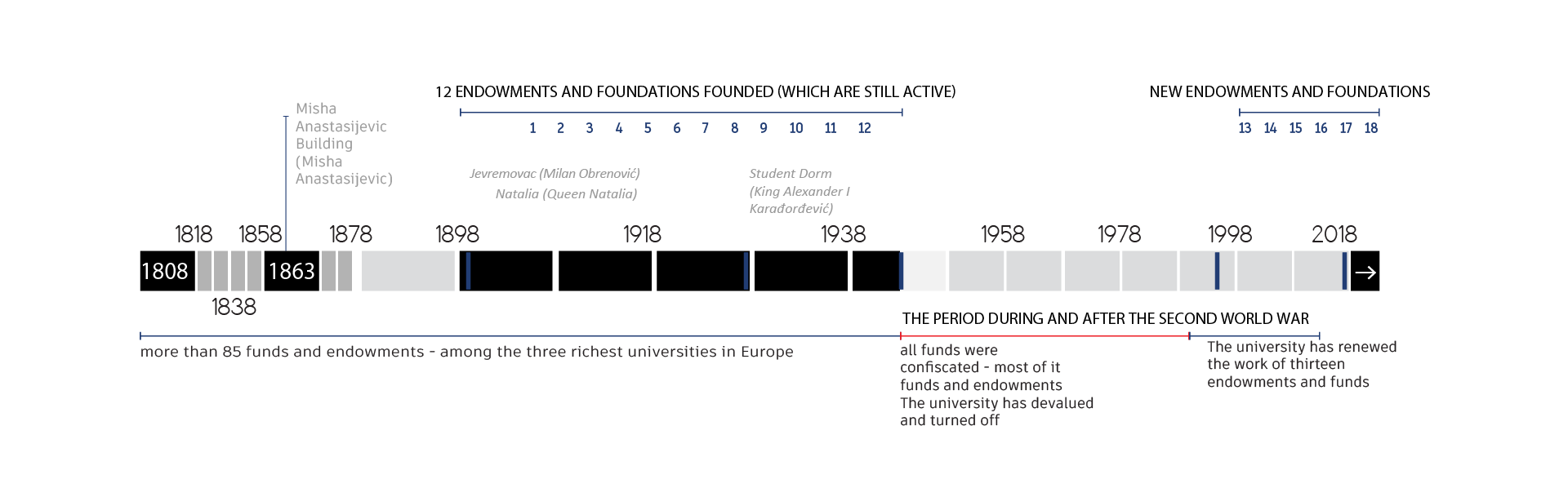
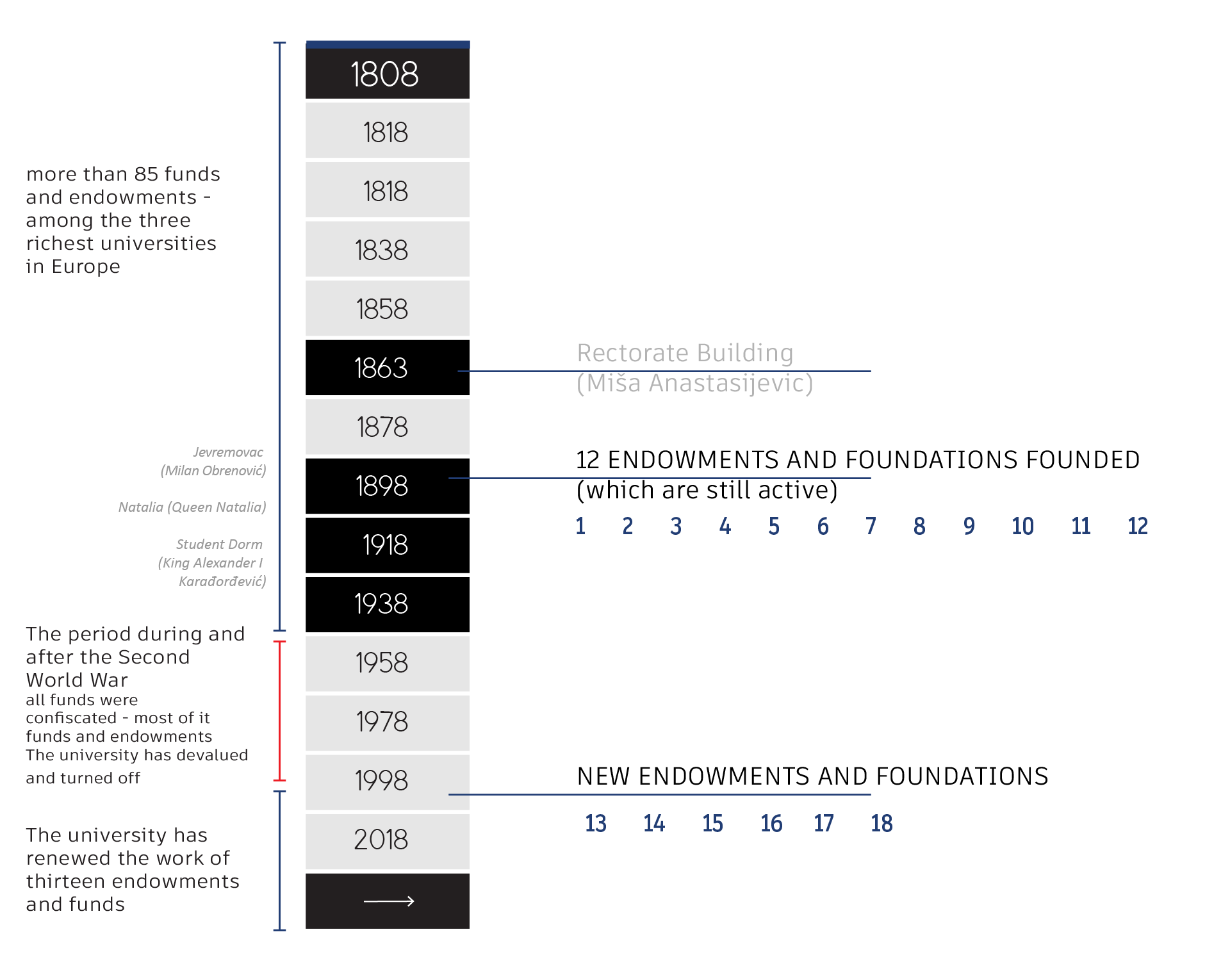
World War II and subsequent historical circumstances brought about a disruption of the rights to access and exploit the assets of the previously established endowments and funds. During the war, all financial assets were confiscated. The postwar period brought about a new ideology which proclaimed a radical showdown with and a break with the past thus drastically devaluing all endowment assets. The new state administration did not spare in the least the oldest existing institution of higher learning in Serbia. The act of ratification of the law of expropriation marked the beginning of confiscation and takeover of all assets and funds of the endowments. This was to go on for the next half century. Thereby, the greatest part of the funds and endowments of the University of Belgrade was depleted of all assets and in fact made invalid. Furthermore, some of the endowments were placed under direct control and used by the state authorities without any financial reimbursment. Flats and living spaces belonging to the endowments and funds were given over, free of any charge, to priviliged individuals while commercial space was put under lease and the finances thus acquired used for purposes other than those stipulated by the foundation documents. In time, the once nationalized assets were also sold to private customers.
Despite such systemmatic abuse and confiscation on the part of the postwar state institutions, an awareness of the significance of donated endowments and funds was never lost in our society. Towards the close of the past century, an initiative was made to register all assets that individual donors or institutions had bequeathed to the University of Belgrade. As a result of that troublesome process, and based on documents issued by the Ministry of Culture of the Republic of Serbia in 1995 and 1996 which made it legally possible for the endowments to resume their activities, the University regained its right to manage its endowments and funds, albeit only thirteen in number.
Four new foundations have been established. In 2020, after the will and testament of the late dr Aleksandar Koturović an endowment bearing his name has been founded. The University was thereby made the recipient and proprietor of two apartments in Belgrade. Today, unfortunately, university endowments and funds are loosing irreversibly their assets through acts of acquisition of previously confiscated living quarters that had once been their integral part. This has been enabled by rejections of restitution appeals.
The University of Belgrade is still adamant in its attempt to retrieve the assets it had been stripped of and return them to the original endowments and funds, as attested also by the Initiative for the Resolution of Status of Property Taken from National Institutions and Endowments under Their Auspeices, submitted in June 2019 by the Serbian Academy of Sciences and the Arts, Matica srpska, and the University of Belgrade to the President of the Republic of Serbia, the Government of the Republic of Serbia, Ministry of Finance, and Ministry of Justice, requiring the drawing and ratification of a lex specialis regarding the Law on restitution of confiscated assets and reimbursement. So far, the responsible state institutions have remained silent in this matter.
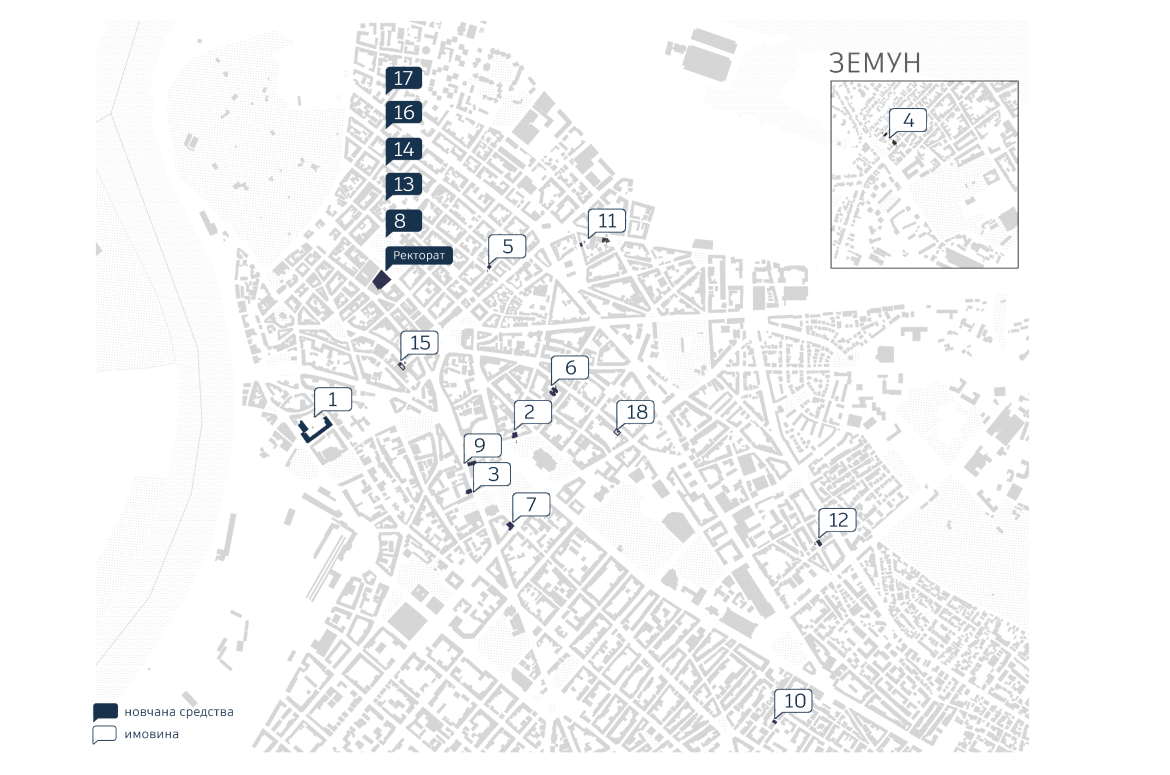
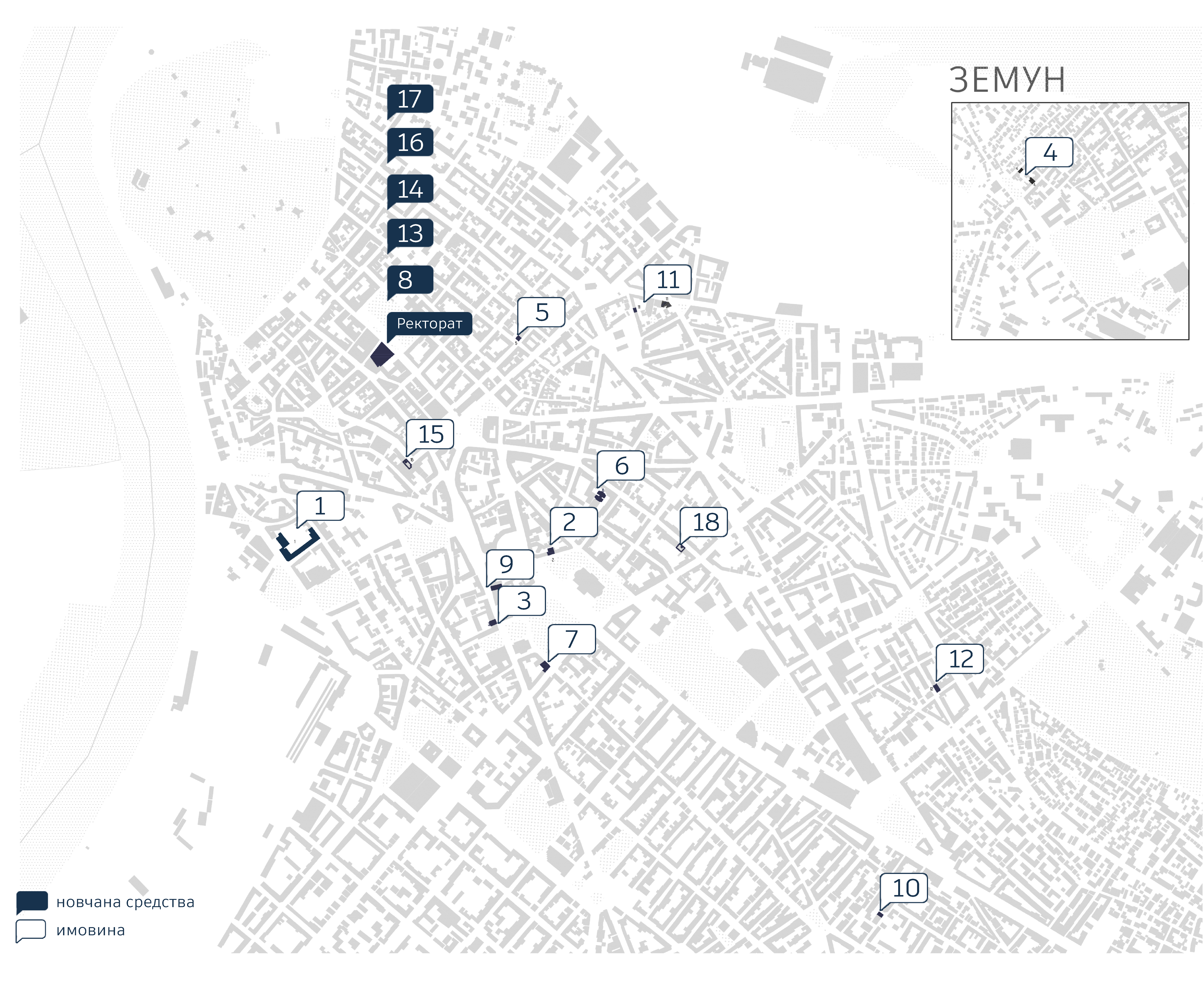
The Luka Ćelović Trebinjac Endowment
The Đoka Vlajković Endowment
The Gašić dr Živana Endowment
The Gliša and Marija Rakić of Zemun Endowment
The Svetozar Vidaković and Wife Magdalena Endowment
The Vlajko Kalenić Endowment
The Milivoje Jovanović and Luka Ćelović Endowment
The Ljubica M. Zdravković Endowment
The Veselin Lučić Endowment
The Aleksandar Koturović Endowment
The Dragoljub Marinković Foundation
The Milan Stefanović Smederevac and Wife Darinka Foundation
The Olga and Miodrag L. Panić Foundation
The Bulajić Sisters Foundation
The Мr ph Ljubica Vojteh Dragićević and ing. oecc. Nikola Dragićević Foundation
The Kosta Migrić Foundation
The New Benefactors of the University of Belgrade Foundation
The Gordana Jokić Kašiković and Dragiša Kašiković Foundation